
What business makes $1,000 a day? A useful answer starts by defining the number and the business activity behind it. A day with $1,000 in sales is different from $1,000 remaining after expenses, and either is different from a repeatable daily result. A business category cannot establish those outcomes for every operator. You need to understand what customers buy, what delivery costs, how much work is required, and whether the proposed volume is supported by evidence.
Explore bicycle flipping with this related channel video. Its title describes the original video; it does not establish expected earnings.
Open the related bicycle flipping video watch page
This article uses hypothetical examples to examine the question. The numbers are arithmetic exercises, not typical earnings or forecasts for The New Flip students. Bicycle flipping is active work with uncertain results. Studying a concrete transaction can help you practice research and communication, but no course establishes daily sales. Treat the target as a prompt for investigation and replace unsupported assumptions with observations before making larger commitments.
Decide what the daily number measures
Write the target as a complete sentence. Does it describe gross sales received, money remaining after direct costs, or overall business profit after shared operating expenses? These measures are not interchangeable. A business selling an expensive item may receive a large payment while having substantial purchase and delivery costs. Keep each amount labeled so the most impressive number does not conceal the responsibilities and expenses behind it.
Also define the period. One favorable day does not establish an ordinary day, and an average across a period can hide days with no completed sales. Record the actual sequence rather than selecting only the strongest event. A useful review explains what happened and what remains unfinished. That gives you a clearer basis for evaluating whether the activity is suitable than a headline whose reporting method is unknown.
Translate sales into an implied volume
Suppose a fictional service sells for $250 per completed project. Four completed projects would produce $1,000 in revenue before expenses. If another fictional offer sells for $100, ten would be needed. These calculations do not establish that customers exist, that the prices are appropriate, or that the work can be completed in one day. They show what the selected assumptions require.
Now ask what each project includes. How much preparation, customer communication, delivery, and follow-up would occur? Could some work have happened earlier? If so, include it in the review. A payment received today may relate to work completed across several days. Calling the entire amount a one-day result without describing that work can make the process appear simpler than the complete record supports.
Examine the amount remaining after direct costs
Use another hypothetical exercise. If a transaction leaves $100 after its direct expenses, ten would leave $1,000 before shared overhead and other obligations. If it leaves $200, five would be needed. These are invented inputs. Do not treat them as expected bicycle-flipping margins or a recommendation to pursue a specific activity. The useful question is what evidence supports the amount you use.
List the direct expenses and shared costs separately. Depending on the business, these could include purchases, supplies, transport, outside assistance, tools, or selling charges. Record the actual categories relevant to the activity. A price difference is not a complete business result when other expenses are omitted. Clear definitions make the comparison useful even when the numbers are modest or the first test does not produce a sale.
Ask how customers would find the offer
A volume calculation does not create demand. Identify a specific customer situation, explain the result you provide, and investigate how people currently solve the problem. Do not assume an audience, referral network, or established reputation that you do not have. Another operator’s results may depend on resources developed over years. Your plan should describe the starting point you actually face.
Track inquiries, agreements, deliveries, and payments as different stages. If people ask questions but do not proceed, review what remains unclear. If the offer does not fit their needs, record that rather than counting the conversation as a future sale. A small evidence log can reveal a useful next test. It is more informative than assuming every person who sees a message will become a customer.
Put the complete work on a calendar
Estimate the time for the entire cycle, then compare it with available work periods. Some tasks require uninterrupted attention, physical meetings, or another person’s availability. A daily total of spare hours may not fit those requirements. Write the actual blocks you could use without neglecting existing responsibilities. This produces a practical schedule instead of a plan that relies on unlimited flexibility.
Include unsuccessful attempts and ordinary delays. A seller may change a meeting, a customer may need clarification, or a project may wait for source material. These events can affect capacity even when no payment occurs. Review them as part of the process. A business does not become repeatable by excluding the tasks that made the strongest transaction harder to complete than its final payment suggests.
Evaluate high-value services carefully
A larger project price can reduce the number of sales implied by the target, but it may also involve more expertise, preparation, responsibility, and delivery work. Do not assume that increasing the price makes customer acquisition or execution easy. Define the actual deliverable and the standard required. If the work exceeds your competence, choose a narrower offer or develop the relevant skill before accepting a commitment.
Prepare an original sample or a detailed project outline. Identify inputs, boundaries, review stages, and what would count as completion. Ask an appropriate potential customer whether the description matches a real need. The exercise helps you understand the offer rather than simply assign a larger number to it. A useful business plan explains why a customer would buy and how you would fulfill the promise.
Study bicycle flipping as a complete transaction
A bicycle-flipping opportunity begins with an actual item. Confirm identity, investigate ownership and condition, research relevant comparisons, and plan the practical handling. A low asking price does not establish a future sale. If a mechanical or structural issue is outside your ability to assess, get qualified help or pass. The purchase decision should reflect what you can responsibly understand and manage.
After buying, you still need appropriate storage, preparation, accurate photographs, a clear description, buyer communication, and handover arrangements. An item may remain unsold. Keep its asking price separate from received payments. The educational value comes from evaluating the complete process and reviewing your decisions, not from assuming every discounted item will produce a favorable result on a fixed daily schedule.
Choose training for a specific learning goal
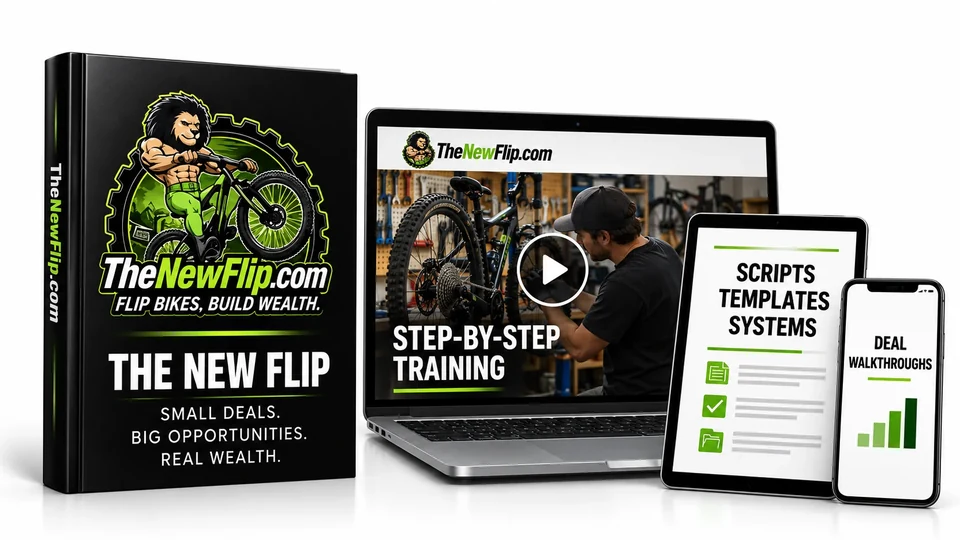
If you want structured bicycle-flipping education, explore The New Flip Complete System and Bicycle Flipping Academy training. The $199 one-time offer is shown against a listed $1,500 comparison price, a $1,301 difference. Review the included book, videos, scripts, templates, and training materials. The package teaches a process to study and apply; it does not establish a $1,000 daily outcome or guarantee a buyer.
For free property education, start the seller financing course from My Real Estate Dojo. Keep the responsibilities of property transactions distinct from bicycle resale. Research and communication habits can be useful practice, but additional knowledge and due diligence are required in another field. Choose the resource that addresses the subject you want to understand rather than treating an income goal as proof of suitability.
Identify the first capacity limit
Ask what would prevent you from serving more customers under the current arrangement. The limit could be preparation time, storage, transport, support, or the ability to check quality. More sales can create more coordination. Do not assume the time and cost of the first transaction stay constant at every volume. A higher-volume scenario should identify what would need to change and the additional expenses that change creates.
Improve one observed bottleneck before increasing commitments. If listings are unfinished, buying more inventory does not finish them. If customers misunderstand scope, attracting more inquiries can create more confusion. Choose a specific change and observe its effect. This is more useful than responding to every difficulty with a larger target or another subscription that does not address the actual problem.
Use a slower-outcome scenario
Create a second version of the worksheet with fewer completed transactions or a longer delivery period. Change one input at a time so you can see what matters. Keep the scenario labeled as hypothetical. Its purpose is to expose the assumptions that deserve investigation, not to predict a failure or select the most attractive result. A plan is easier to assess when its uncertainties are visible.
Choose a practical observation that could improve the weakest input. You might time a complete service sample, document all costs on a transaction, or review how many inquiries become completed appointments. Gather information you can check directly. More elaborate arithmetic cannot compensate for an unknown customer need or an untested skill. The next action should improve your evidence rather than decorate the forecast.
Turn the question into a manageable test
Write the target, define the measure, list the assumed transaction amount, and calculate the implied volume and work. Then mark unsupported inputs and choose one limited experiment. A useful outcome may be a clearer offer, a completed transaction review, or a decision to pursue more learning. None requires pretending that an ambitious daily number is already established or dependable.
If bicycle flipping is the process you want to study, review The New Flip Complete System and connect the lessons to your own checklist. For free property education, begin the seller financing course. Start with one defined learning goal and an honest review. Use the evidence to decide what deserves the next commitment of your time and resources.

