
Searching for a bicycle flipping business book free can mean you want to explore the subject before buying education. That is a useful goal, but it helps to identify what a resource actually provides. A public video, a sample chapter, a checklist, and a complete paid training package are different offers. Do not assume that a search phrase describing a free book means an official free edition of a particular paid resource exists.
Related bicycle-flipping video. Its original title and examples do not establish expected earnings.
Open the related video watch page
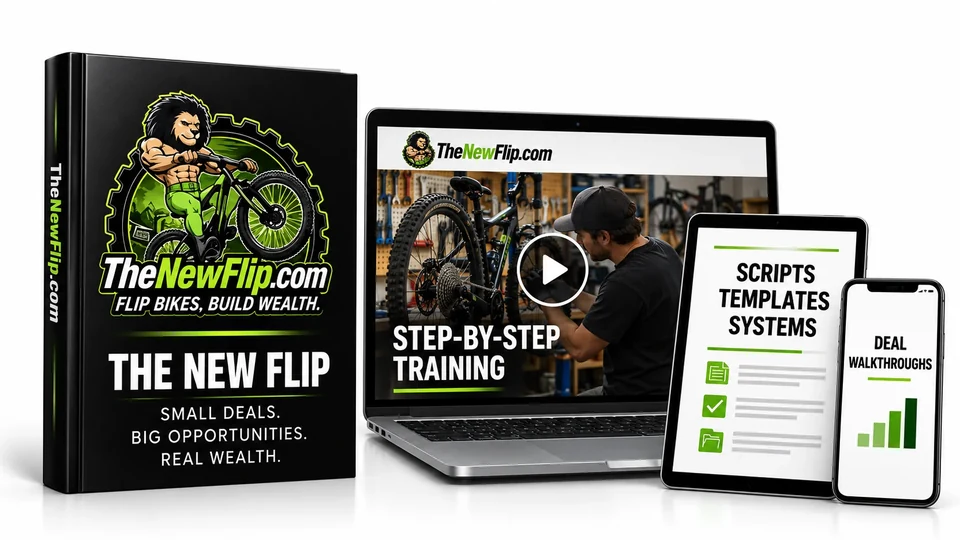
The New Flip Complete System is paid bicycle-flipping education. This article does not offer an unauthorized copy or describe the $199 package as free. It explains how to use legitimate public learning and decide whether structured training addresses a remaining gap. The separate free seller-financing course concerns property education. It is a relevant learning option for interested readers, but it is not a free bicycle-flipping book or the same curriculum.
Define what you want to learn before downloading
Write one question you need answered. Perhaps you want to understand the complete transaction, identify models, compare asking prices, or learn what work continues after a purchase. A defined question helps you evaluate a free resource’s usefulness. Without it, a large collection of files can feel like progress while the important decision remains as unclear as before.
Choose a resource because it addresses that question, not because its title promises a dramatic result. Public examples can be interesting and useful while covering only part of the process. Record what was actually explained and what remains open. This keeps a brief introduction from being mistaken for comprehensive training merely because it was easy to access or appeared prominently in a search.
Use legitimate sources and stated offers
Begin with the author, publisher, or authorized provider. If a free sample or public lesson is available, read the description and scope. An unfamiliar page offering a paid title without clear authorization should not be treated as the correct access route. Ask the actual provider about access rather than supplying personal information to an unclear download service.
Keep the source and date with your notes. A third-party summary may express an interpretation rather than reproduce the author’s method accurately. A sample may intentionally omit later material. Neither is automatically useless, but each needs to be understood for what it is. Accurate source records make it easier to revisit a lesson without confusing separate materials or assuming every file belongs to the same package.
Treat public videos as focused lessons
Select a clip connected to your learning question and look for the decision sequence. What information was known before the purchase? Which tasks were shown? Which costs were stated? What remained unexplained? Record those distinctions. A title reporting an impressive outcome should not become an expectation about your own inventory or a substitute for local research.
After watching, complete a small exercise. You might draft a seller question or identify the evidence needed to confirm a model. The exercise is useful even if no purchase follows. It turns passive viewing into a test of understanding and gives you something specific to review. Another clip should answer a new or unresolved question rather than simply repeat the emotional appeal of a favorable sale.
Build your own learning checklist
Organize the process into research, clarification, condition assessment, purchase decision, handling, listing, buyer conversation, handover, and review. Mark which stages your current free resources actually address. Leave gaps visible. A collection can contain many minutes of content while still omitting the ordinary work that determines whether you can responsibly complete a transaction.
Write a next learning action for each important gap. You may need a qualified source, a clearer example, or practice with your own record. The checklist should help you decide what to study next, not award completion because every box contains a note. An honest blank is more useful than a confident statement based on material that never answered the question.
Practice without making a purchase promise
Choose a listing as an identification exercise. Record supported details and unknowns, then write the questions that would improve the decision. Do not claim to be a committed buyer if you are merely studying an advertisement. You can learn a great deal by reviewing available evidence without involving a seller or creating an arrangement you do not intend to honor.
If you genuinely investigate an item, keep messages accurate about your interest and conditions. An inspection or further clarification may be necessary before deciding. Free learning should improve the quality of the conversation rather than encourage pressure tactics copied from an unrelated example. Respectful, specific questions are a practical skill and can be reviewed without assuming a particular script guarantees agreement.
Keep condition limits visible
A no-repair resale approach does not remove the need to understand condition. Public material may show visible details without teaching you to assess every issue. If mechanical or structural safety is uncertain, seek appropriate qualified help or decline the opportunity. Do not let the absence of a training budget become a reason to take on a problem outside your knowledge.
Write down the boundaries of your process. Which issues require further assessment, and which make the item unsuitable for your intended approach? A useful free lesson can help identify those limits without resolving every technical question. The goal is a responsible decision from evidence, not a purchase made to prove that you have begun a business.
Learn complete records rather than isolated margins
Create separate lines for purchase, transport, preparation, outside help, selling expenses, shared costs, and time. Mark hypothetical inputs as assumptions. An advertised resale figure is not a completed outcome. If a public example states only purchase and sale, preserve the missing expense categories as unknown rather than assuming they were zero.
Use the worksheet to ask better questions about any result. What period does it cover? Did the item actually sell? Which tasks happened before the final payment? This approach makes free learning useful because it develops the method for evaluating evidence. It does not require adopting another person’s reported margin as a forecast for a different bicycle or market.
Compare paid structure with your remaining needs
After several exercises, review what remains fragmented. You may want a connected sequence, written reference, adaptable scripts, or examples organized around the same process. Those are legitimate reasons to consider structured education. Evaluate the current contents and delivery rather than assuming every paid offer includes coaching, community access, a website, or software shown elsewhere.
You may also choose to continue learning through public material. Keep the sequence deliberate and the gaps visible. The decision should fit your circumstances and the question you are trying to answer. Neither the absence nor presence of a purchase proves that the knowledge has been applied. What matters is whether your understanding improves enough to support a responsible next step.
Distinguish free property education from bicycle training
The free seller-financing course at My Real Estate Dojo is a separate subject. It may interest readers considering entrepreneurship or property education, but it should not be described as the same resource as The New Flip bicycle-flipping book. Keep course names and purposes accurate when planning what to study. A relevant free link does not make every related educational product free.
Likewise, practice with a bicycle transaction does not establish readiness for a property transaction. Different responsibilities require additional learning and due diligence. You can explore both subjects while keeping their limits clear. The practical connection is developing careful questions, accurate records, and deliberate decisions, rather than assuming one lesson supplies all the knowledge required for every business opportunity.
Make your free-learning plan measurable
Choose one question, one legitimate source, and one exercise for the next session. Record the result and the remaining uncertainty. A useful milestone might be an accurate identity record or a clearer seller message. These outcomes are more concrete than the number of files downloaded. They show whether the resource helped you understand a task you may actually need to perform.
At the review point, decide whether to continue, investigate a gap, or compare structured training. Keep the choice honest about the stated offer and your resources. The next step does not need to be a purchase. It should improve what you can explain and responsibly do. Legitimate free resources can support that process without misrepresenting a paid book or treating another person’s outcome as a guarantee.
Choose your next learning resource
If you want structured bicycle-flipping education, review The New Flip Complete System and Bicycle Flipping Academy training. The current offer is $199 one time, displayed against a listed $1,500 comparison price, a $1,301 difference. Review the book, videos, manuals, seller scripts, purchase offers, ad copy, and deal examples on the product page. This self-paced educational package is separate from optional community, individual coaching, and hosted business technology. Choose the resource because its stated contents address a skill you want to study, rather than assuming that a purchase establishes customers, suitable inventory, sales, or profit.
For a free introduction to property education, start the seller financing course at My Real Estate Dojo. That is a separate subject, not a free edition of the paid bicycle-flipping package. Keep each activity’s responsibilities distinct and seek qualified help for questions outside your knowledge. When you are ready to continue, explore The New Flip Complete System, or begin with the free seller financing course. Connect the lesson to one manageable exercise, record what you learn, and use that evidence to choose a responsible next step.

