
Learning how to flip bikes for profit begins with understanding what the numbers actually measure. A resale amount is not the same as profit, an asking price is not a completed payment, and a price difference may omit meaningful expenses. Before making an offer, identify the bicycle, evaluate suitability, investigate the market evidence, and estimate the complete work. The calculation should support a decision based on facts rather than turn an attractive discount into apparent certainty.
Related bicycle-flipping video. Its original title and examples do not establish expected earnings.
Open the related video watch page
This guide uses hypothetical examples, not expected margins or typical student earnings. The New Flip teaches a no-repair resale approach, but selecting an appropriate bicycle still requires condition awareness and accurate representation. Get qualified help when an issue exceeds your ability to assess. Your decisions, purchase costs, local demand, timing, and execution affect the outcome. No worksheet or course can establish a buyer or guarantee a profitable sale.
Define the result you want to examine
Begin with a completed sale payment and the actual expenses associated with the transaction. Shared operating costs may also need consideration when reviewing the business as a whole. Keep each category explicit. A story describing purchase and sale alone may provide useful information without establishing the complete result. Do not make the numbers look better by quietly excluding categories that another comparison includes.
Track your time separately across research, messages, meetings, preparation, listing, and handover. An activity performed after work still uses capacity. Include unsuccessful attempts where they are part of the process. The record should help you decide whether the activity fits your circumstances, not simply produce the most attractive percentage from the smallest possible selection of costs.
Begin with the actual bicycle
A financial estimate depends on identifying the item correctly. Confirm the model, size information, configuration, included items, and supported condition details. Keep seller statements separate from facts you establish. If the identity remains uncertain, the comparison evidence may also be uncertain. Do not use a higher-specification catalog version to supply a value for an unverified bicycle merely because the name looks similar.
Condition can change whether the item belongs in your intended process. A no-repair approach is not a plan to ignore problems. If a concern requires assessment beyond your knowledge, seek appropriate help or decline. A low purchase price does not compensate for information you cannot responsibly establish. The worksheet should preserve that unresolved question instead of turning it into an assumed small expense.
Choose relevant comparison evidence
Record why each reference is comparable. Look at the actual model, configuration, condition description, location, date, and whether the figure is an asking price or a completed result. These distinctions matter. A popular-looking advertisement does not establish the final selling amount or the time required to find a buyer. Keep the limits of the evidence visible in your notes.
If references differ substantially, explain the differences rather than averaging them into a single confident number. A smaller group of relevant examples may be more useful than many unrelated screenshots. The result can be that the available evidence is insufficient. That is a decision-relevant conclusion. You do not need every research exercise to end with a precise estimate or a reason to purchase.
Build the direct-cost worksheet
List purchase, collection, transport, preparation, qualified outside assistance, selling expenses, and any other transaction costs that apply. Mark an estimated amount as an assumption until supported. Do not assume a missing quote will be negligible. An essential unknown should remain a reason for further investigation, especially when it could materially affect whether the item fits your resources.
Keep the date and source beside each figure. A confirmed cost, a historical example, and a guess should not look identical. This makes the worksheet easier to revisit when facts change. If the pickup moves farther away or an assessment identifies another concern, update the calculation before deciding. The original, easier scenario should not continue justifying an offer after its assumptions no longer apply.
Use a hypothetical transaction correctly
Imagine an invented purchase at $80 followed by a completed sale at $220. The $140 price difference is not yet the full business result. If hypothetical direct expenses total $45, $95 remains before shared overhead and other obligations. These numbers illustrate the method only. They do not describe a real available bicycle or an amount a reader should expect to achieve.
Now identify what evidence would be needed for each input. You would need the actual purchase terms, supported expense information, and a sale that really occurred. Before the sale, the resale figure belongs in a scenario rather than the completed record. This distinction allows useful planning without describing an uncertain future amount as money already earned.
Examine a less favorable scenario
Change one input at a time. What if the eventual selling amount is lower, the collection expense is higher, or the item remains unsold longer than expected? The exercise should reveal which assumptions matter most. It is not a prediction of the outcome. Keeping alternatives visible makes the purchase decision easier to assess than presenting one optimistic figure as the only possibility.
Then investigate the weakest assumption. You may need a closer market reference, a confirmed transport arrangement, or qualified condition advice. Gather information that improves the actual decision. More elaborate arithmetic cannot validate weak inputs. A detailed spreadsheet with unsupported numbers remains uncertain even when it produces a precise-looking result to two decimal places.
Keep unsold inventory out of completed results
An advertised bicycle has not produced a sale merely because the listing is complete. Record its purchase cost, status, remaining work, and time in the process. Keep possible future values separate from actual payments. This prevents a collection of asking prices from looking like received income and helps you see how much attention and capacity remain committed.
Decide what you will review if the item does not sell as hoped. The issue may involve description clarity, relevance, condition information, timing, or price assumptions. Choose a specific next action rather than buying more inventory to make the overall plan appear larger. Expanding the number of unfinished items is different from improving the process that handles one item responsibly.
Evaluate the seller offer as a complete arrangement
The price is one term. Included items, inspection conditions, timing, and collection arrangements also matter. State the next step clearly and avoid implying certainty before your essential checks are complete. If the seller changes the facts, reassess the revised offer. A discount should not erase a condition or ownership concern that remains unresolved.
Keep a decision note describing what you expected, what changed, what remains unknown, and whether you will continue. This helps separate evidence from the pressure created by previous messages or travel plans. Time already spent researching is not a reason to accept an unsuitable purchase. Passing on a deal can be a successful application of the process you are trying to learn.
Review the work behind the completed outcome
After an appropriate sale, record the actual figures and compare them with your earlier assumptions. Which costs were missed? Which tasks used more time? Which description answered buyer questions well? The review should include a disappointing result with the same honesty as a favorable one. Selective records make the next decision less informed rather than more encouraging.
Choose one change you can test. Perhaps identifiers should be requested earlier, a meeting needs a clearer recap, or expense notes should be updated immediately. Connect the improvement to an observed issue. Broad instructions to work harder are less useful because they do not identify which action would change. A repeatable learning process develops through specific records and practical adjustments.
Connect profit goals with responsible execution
A desire for additional income can motivate useful study, but it should not turn a hypothetical estimate into a dependable forecast. Evaluate whether the actual workload fits your schedule and whether the resources are available. One unusually favorable transaction does not establish ordinary results or justify a larger commitment without further evidence. Keep the scale of the next test manageable.
The practical path is research, supported assessment, a clear offer, accurate marketing, and a complete review. Training materials can organize those steps and provide examples, but the operator still makes the decisions. Use the numbers to expose uncertainty and guide questions. The strongest calculation is one whose inputs you understand, whose limits remain visible, and whose next action you can responsibly perform.
Choose your next learning resource
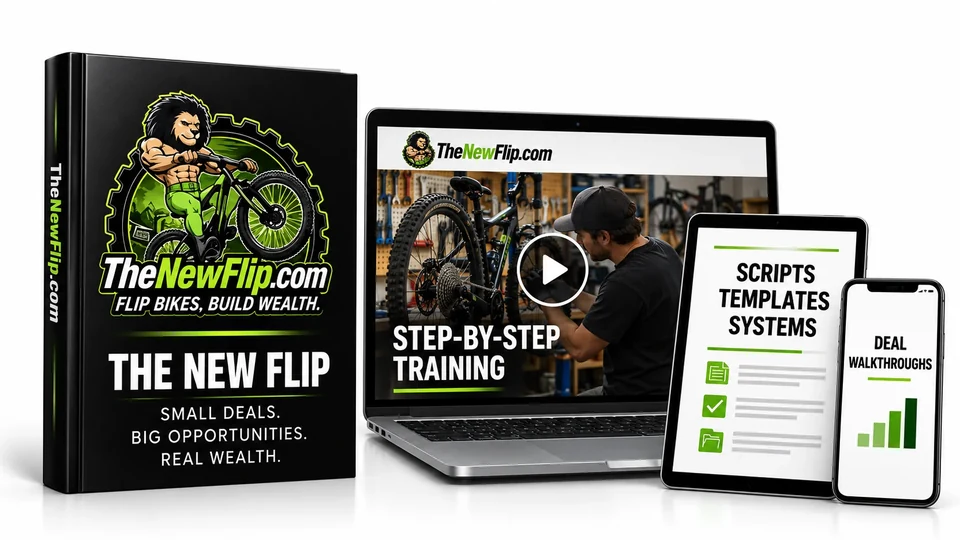
If you want structured bicycle-flipping education, review The New Flip Complete System and Bicycle Flipping Academy training. The current offer is $199 one time, displayed against a listed $1,500 comparison price, a $1,301 difference. Review the book, videos, manuals, seller scripts, purchase offers, ad copy, and deal examples on the product page. This self-paced educational package is separate from optional community, individual coaching, and hosted business technology. Choose the resource because its stated contents address a skill you want to study, rather than assuming that a purchase establishes customers, suitable inventory, sales, or profit.
For a free introduction to property education, start the seller financing course at My Real Estate Dojo. That is a separate subject, not a free edition of the paid bicycle-flipping package. Keep each activity’s responsibilities distinct and seek qualified help for questions outside your knowledge. When you are ready to continue, explore The New Flip Complete System, or begin with the free seller financing course. Connect the lesson to one manageable exercise, record what you learn, and use that evidence to choose a responsible next step.

