
A bicycle flipping course for beginners should explain what to do before buying inventory. The first useful lessons involve identifying a bicycle, asking clear questions, understanding uncertainty, and planning the complete transaction. A strong learning sequence gives you exercises you can complete without pretending that every listing is a good opportunity. Begin by asking how the training turns unfamiliar tasks into a process you can understand and review.
Related bicycle-flipping video. Its original title and examples do not establish expected earnings.
Open the related video watch page
This guide organizes the first four practice sessions around preparation, research, communication, and presentation. They are suggested learning exercises, not a promise that four sessions make someone an expert. Your knowledge, available time, and the particular bicycle matter. The New Flip Complete System combines written training and supporting materials, but you still need to study, make your own decisions, and seek qualified help when an issue exceeds your competence.
Session one: explain the complete transaction
Write the stages of a possible bicycle resale from the first listing review through the final handover. Include the ordinary tasks that happen between the exciting moments: seller clarification, inspection arrangements, transport, storage, preparation, photographs, buyer questions, and record keeping. The sequence reveals whether your original picture of the business included the work you would actually perform.
Next, identify the stage you understand least. A beginner course should help you locate that gap rather than imply that motivation alone resolves it. Write a specific learning question and use the relevant lesson to address it. If the training demonstrates only the final sale, look for further material about the earlier decisions. A connected process is more useful than a collection of outcomes with no explanation of how the operator reached them.
Make the course scope visible
Separate education, group access, private coaching, and hosted software. These can be different products with different terms. Do not assume that a video showing automation means an entry-level educational purchase includes the software shown. Read the current product page and ask what the selected package provides. A clear scope helps you decide whether the resource meets the learning need you actually have.
For The New Flip, the Complete System is self-paced education with the book and listed supporting materials. Optional community, coaching, and hosted business packages have their own arrangements. Review them separately. You do not need to buy every option to understand the basic distinction. The useful first purchase decision concerns which lessons and tools you need now, rather than every resource that could conceivably support a later business.
Session two: build a bicycle identity record
Select one advertisement as a research exercise. Record the stated brand, model, size, configuration, and included accessories. Attach the available photographs to the same note. Mark whether each statement comes from a visible identifier, the seller’s description, or your own unconfirmed interpretation. This prevents a possible match from becoming a remembered fact later in the week.
Write the next question that would most improve the record. A clear model photograph may be more useful than another broad message asking whether the bicycle is good. If a detail remains unknown, keep it unknown. The exercise should reward accurate distinctions rather than complete-looking forms. A course is useful when it improves the quality of the questions you ask before a commitment.
Add condition boundaries to the record
Identify the concerns you cannot assess appropriately. Public demonstrations can introduce visible details, but they do not establish your ability to evaluate every mechanical or structural issue. Get qualified assistance where needed or pass on the opportunity. A no-repair approach still depends on selecting suitable bicycles and describing them accurately, rather than ignoring a problem because you do not intend to fix it.
Write three conditions that would stop your purchase process. Make them observable, such as an unresolved identity mismatch or a concern outside your knowledge. The exact boundaries should fit your capabilities. Their purpose is to preserve the decision process when a low asking price becomes distracting. A beginner exercise can end successfully with a decision not to buy.
Session three: practice a clear seller message
Draft a message requesting the information required for the next decision. Keep it respectful and concise. Do not imply that the seller owes you a discount or that a purchase is certain before your checks are complete. State your interest honestly and explain an inspection condition where relevant. Clear communication helps both people decide whether continuing makes sense.
Then draft a recap of a hypothetical agreement. Identify the bicycle, included items, proposed terms, timing, and the next action. Read it from the seller’s perspective. Could a different interpretation create a problem later? A course may supply scripts, but you need to adapt them to the actual facts. Copying language without understanding its meaning can introduce promises you did not intend to make.
Learn to use scripts as working tools
A script can reduce the effort of starting a conversation. It should not override the information in front of you. Remove statements that are untrue, adjust the question to the actual bicycle, and stop when an answer needs investigation. The best learning outcome is understanding why a sentence belongs in the conversation, not merely memorizing words that appear to have worked in another transaction.
Save a version of your practice message and annotate what each part does. One sentence identifies the item, another asks for evidence, and another clarifies the next step. This makes the script easier to adapt later. You can then recognize which parts need changing when the seller has a different need or the arrangement develops in a different direction.
Session four: prepare an accurate buyer-facing listing
Use the identity record to draft an advertisement. Include supported details, relevant photographs, actual included items, and known limitations. Do not borrow a higher specification from a similar version or repeat an original-price claim without understanding its source. The listing should allow a buyer to judge the actual bicycle rather than the most attractive catalog description you found.
Ask another person to explain what they believe the draft offers. Their interpretation can expose missing information or an unintended promise. Revise the wording accordingly. This exercise connects research with customer expectations. A beginner course should help you understand that marketing and accuracy belong together, because the future handover needs to match the offer the buyer read.
Review progress before purchasing inventory
Compare your first notes with the final exercise. Can you explain the process more clearly? Do you know which facts are confirmed? Can you state what still needs qualified assessment? Have you identified workable transport and storage arrangements? These are more useful early milestones than simply owning a bicycle. An item in your home does not prove the process has been understood.
Choose one area for further practice and review the relevant lesson. There is no need to make every exercise end in a transaction. Education is useful when it improves your ability to make a supported decision, including declining an unsuitable opportunity. Use the written and video materials to close a specific knowledge gap, then test your understanding through another manageable exercise.
Add a fifth session for unanswered questions
Reserve another practice period for the information you could not resolve. Choose one item from the identity record and write exactly why it matters. If the issue concerns condition beyond your competence, the next action is appropriate qualified assistance or declining the opportunity, not another guess. If it concerns a missing identifier, locate the evidence needed before using comparison figures. This session should close a specific knowledge gap rather than restart the entire course without a question.
Prepare a short explanation of your decision for yourself. State what is confirmed, what remains unknown, and what action follows. You do not need to persuade anyone that every researched bicycle deserves a purchase. The exercise helps you recognize whether the course has improved your ability to distinguish evidence from enthusiasm. A deliberate pause can be a better application of the training than completing a transaction on assumptions you cannot support.
Keep a record of the time required for the exercises too. Research, learning, and practice occupy real capacity alongside an existing job or family commitments. Use the observation to plan a realistic study routine. If one session takes longer than expected, narrow the next exercise instead of treating the schedule as a reason to skip an essential check. A beginner’s learning plan should develop reliable habits at a manageable pace, with a clear understanding of the tasks and the limits that remain.
Choose your next learning resource
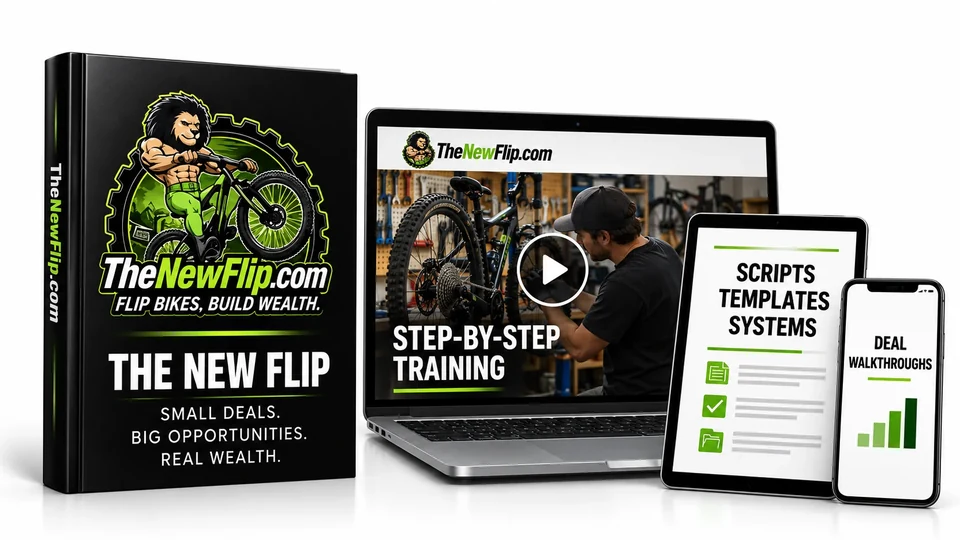
If you want structured bicycle-flipping education, review The New Flip Complete System and Bicycle Flipping Academy training. The current offer is $199 one time, displayed against a listed $1,500 comparison price, a $1,301 difference. Review the book, videos, manuals, seller scripts, purchase offers, ad copy, and deal examples on the product page. This self-paced educational package is separate from optional community, individual coaching, and hosted business technology. Choose the resource because its stated contents address a skill you want to study, rather than assuming that a purchase establishes customers, suitable inventory, sales, or profit.
For a free introduction to property education, start the seller financing course at My Real Estate Dojo. That is a separate subject, not a free edition of the paid bicycle-flipping package. Keep each activity’s responsibilities distinct and seek qualified help for questions outside your knowledge. When you are ready to continue, explore The New Flip Complete System, or begin with the free seller financing course. Connect the lesson to one manageable exercise, record what you learn, and use that evidence to choose a responsible next step.

